The experience
The Ardentilla of Holbox
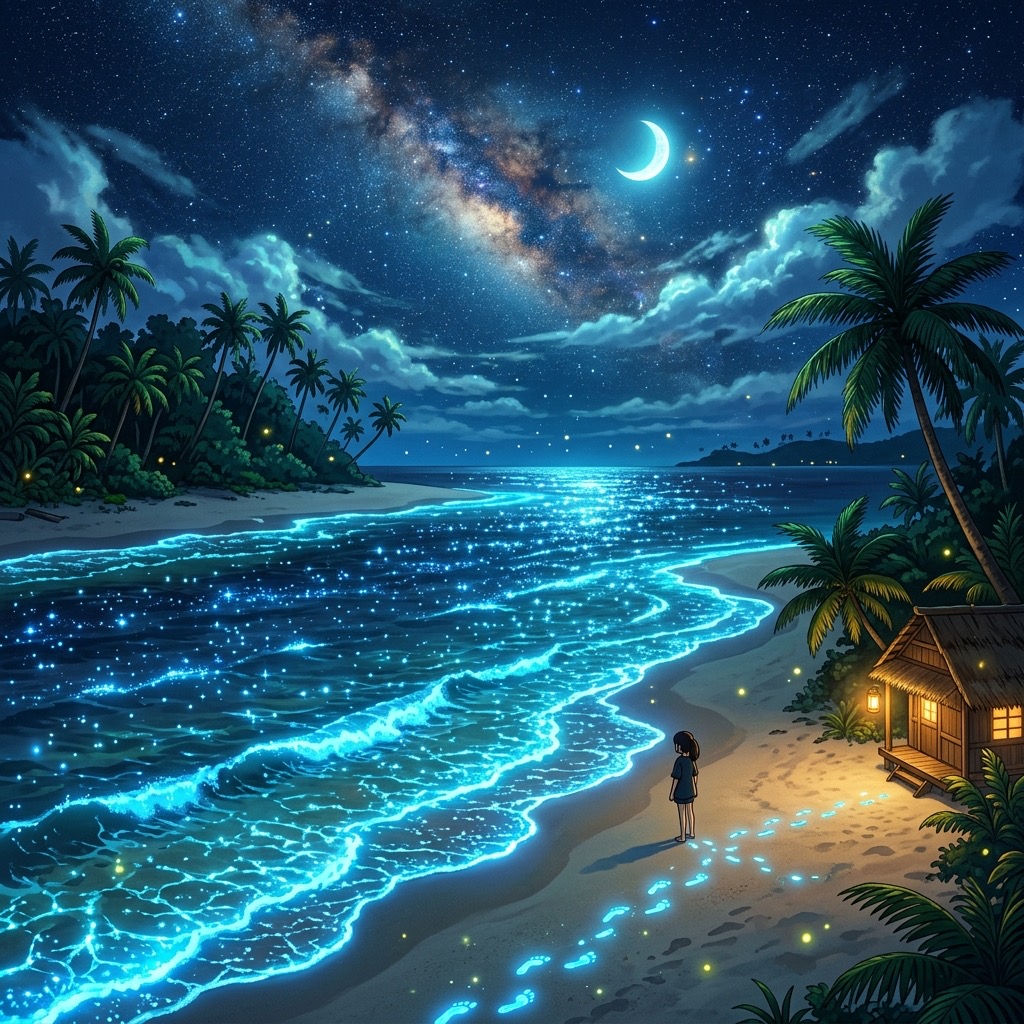
Holbox fishermen call it "ardentilla" — a cold blue fire that ignites behind their boats when they navigate at night. For them it is ordinary, part of the seascape they have known their entire lives. For everyone else, it ranks among the most sought-after natural phenomena in the Mexican Caribbean, drawing travelers from dozens of countries who fly to the Yucatan Peninsula for this single experience.
The organism responsible is Pyrodinium bahamense, a species of dinoflagellate — single-celled plankton that produces light through a chemical reaction triggered by mechanical disturbance. When a paddle strikes the water, when a hand sweeps beneath the surface, or when a fish darts away from your kayak, millions of these organisms fire simultaneously. The result is a blue-green glow that traces every movement, then slowly fades into darkness. It is bioluminescence in its purest, most accessible form.
The tour departs from the town pier after 8 PM. Kayaks glide silently past the hotel zone, leaving behind the last artificial lights, and head toward Punta Cocos in total darkness. The transition is part of the experience: as your eyes adapt and light pollution disappears, the water begins to reveal its secret. Each paddle stroke leaves a luminous trail that dissolves behind you. Moving your hand through the water feels like holding liquid stars between your fingers. Fish fleeing the kayak leave comet tails of light — bright streaks that cross beneath the surface and vanish into the deep.
Punta Mosquito also produces good bioluminescence, but access depends on tides and is not always possible by kayak. Punta Cocos, farther from town, has the advantage of minimal light pollution, which allows you to see the phenomenon at its most intense and contrasty. This is where the best operators take their groups, and the difference compared to staying near the hotel zone is dramatic.
Science
What Causes the Glow
Pyrodinium bahamense belongs to a genus of armored dinoflagellates found in tropical and subtropical waters throughout the Caribbean basin. In Holbox, these organisms thrive in the shallow, nutrient-rich waters where the Gulf of Mexico meets the Yalahau Lagoon — a mixing zone that provides the perfect cocktail of warm temperatures, organic nutrients from surrounding mangroves, and calm, sheltered conditions.
The light itself is produced by an enzyme called luciferase acting on a substrate called luciferin, a reaction that requires oxygen and is triggered by physical agitation. Every time you disturb the water, the cell membrane deforms, ion channels open, and the chemical cascade fires in milliseconds. The blue-green wavelength (around 475 nanometers) is not a coincidence — it travels farthest through seawater, which is why bioluminescence across marine species converges on this same color.
What makes Holbox distinctive is not the intensity alone — Mosquito Bay in Puerto Rico and Luminous Lagoon in Jamaica are documented as having higher dinoflagellate concentrations. The advantage here is the setting: open-water kayaking under a starlit Caribbean sky, with no concrete docks, no motorized boats, and far fewer crowds. The experience is raw and immersive in a way that managed bioluminescent bays rarely achieve.
Seasonality
When to See the Bioluminescence
March through May: Low intensity. Dinoflagellates begin activating as water temperatures climb to 77-81°F (25-27°C). Bioluminescence is visible but faint. You need well-adapted eyes and favorable moon conditions to appreciate it. Many visitors in this window leave underwhelmed because they expected the peak-season spectacle.
June through August: Peak intensity. Water reaches 82-84°F (28-29°C) and nutrient concentration hits its annual maximum. July is the single best month. On new moon nights, the intensity can be spectacular — the water appears to ignite with every movement. This is the window that justifies planning a trip specifically for bioluminescence.
September and October: High to moderate. Water remains warm, but heavy seasonal rains can increase turbidity and dilute dinoflagellate concentrations. Clear nights following several rainless days remain excellent. The unpredictability is higher, but the rewards on good nights rival peak summer.
November: Moderate and declining. Water cools to about 79°F (26°C) and dinoflagellate activity drops progressively. Bioluminescence is still visible on dark nights, but the intensity no longer compares to summer months.
December through February: Very low or imperceptible. Cold water — 75-77°F (24-25°C) — reduces the dinoflagellate population to its annual minimum. Many operators suspend tours during these months because the experience does not justify the price. If bioluminescence is the reason for your trip, do not come in winter.
The critical factor: the moon. Lunar phase matters as much as the season. During a new moon, darkness is total and bioluminescence reaches its full visual magnitude. During a full moon, ambient light washes out the plankton glow almost completely, even in peak July. Planning your trip around the lunar calendar is as important as choosing the right month. Check a moon phase calendar before booking flights.
Tour details: $40-70 USD per person. Duration 2 to 2.5 hours by kayak with a guide. Departure after 8 PM from the town pier toward Punta Cocos. Most operators provide double kayaks and life jackets. No prior kayaking experience is required — the water is calm and shallow.
Practical details
What to Bring and What to Expect
Leave your phone expectations at the hotel. Bioluminescence does not photograph well with smartphone cameras — the light is too faint and diffuse for auto-exposure to capture. Professional cameras with manual settings, high ISO capability, and long exposures can get results, but the best approach is to put the device away and experience it with your eyes. Tour guides will usually take a few shots with their own equipment and share them afterward.
What to bring: mosquito repellent (biodegradable, reef-safe — operators may reject chemical sprays), a dry bag for valuables, water shoes or sandals with straps, a light long-sleeved shirt for the paddle back. Leave the GoPro behind unless you have specific low-light settings configured in advance.
What to wear: swimsuit under light clothing. You will get wet. Some tours include a swimming stop where you can enter the water and watch your body glow as you move — this is the highlight for most participants.
Physical demands: moderate. The paddle to Punta Cocos takes 30-45 minutes each way, with the viewing stop in between. No experience is needed, but basic fitness helps. Children over 6 can usually participate with an adult in a tandem kayak. Operators will brief you on paddle technique before departure.
Booking tips: reserve 2-3 days in advance during peak season (June-August). Confirm the moon phase before committing — a responsible operator will advise you if conditions are unfavorable and suggest alternative dates rather than take your money for a subpar experience.
Common myths
Myths vs. Reality
"You can see bioluminescence any night of the year."
There is a pronounced seasonality: peak is June through August, and in winter the activity is minimal or nonexistent. But even in high season, the moon rules. A full moon night in July can be worse than a new moon night in October. Without darkness, there is no show. Check both the season and the lunar calendar before planning your trip.
"Holbox has the strongest bioluminescence in the world."
Holbox's bioluminescence is real and beautiful, but Mosquito Bay in Puerto Rico and Luminous Lagoon in Jamaica are classified as more intense due to higher dinoflagellate concentrations. Holbox's advantage is different: an open-water kayak experience with fewer crowds, no massive infrastructure, and the starry Caribbean sky as a backdrop. The setting compensates for what raw intensity lacks compared to those famous bays.
"Touching or swimming in bioluminescent water is dangerous."
The dinoflagellates responsible for the bioluminescence are not toxic at normal concentrations. Swimming among them is part of the experience and completely safe. The genus Pyrodinium can produce toxins, but only during massive blooms (red tides), which are distinct events visible to the naked eye and extremely rare in Holbox waters. Your tour guide will confirm conditions before any swimming stop.
"All tour operators deliver the same experience."
Tour quality depends on moon positioning, departure time, the zone chosen, and how the operator manages light pollution. The best operators choose new moon nights, depart after 8:30 PM when darkness is complete, and paddle all the way to Punta Cocos — far from town lights and hotels. An operator that departs early or stays near the hotel zone delivers a notably inferior experience. Ask specifically where they go and whether they check the lunar phase before confirming your booking.
Frequently asked questions
What people ask
When is the best time to see it?
July is peak month, June and August are also excellent. Moon phase matters more than the month: new moon or quarter moons are ideal.
How much does the tour cost?
$40–$70 USD per person, guided kayak tour, 2–2.5 hours. Book in advance for July new moon dates.
Where is the best spot?
Punta Cocos, away from town light pollution. Punta Mosquito is the second-best spot.
Can you see it from shore?
In July during new moon it may be visible from dark beaches, but the kayak experience is significantly more intense.
What is ardentilla?
Local name for marine bioluminescence. Dinoflagellates like Pyrodinium bahamense emit blue-green light when the water is agitated.
Next step