Local context
A Car-Free Island Where Everything Starts at the Pier
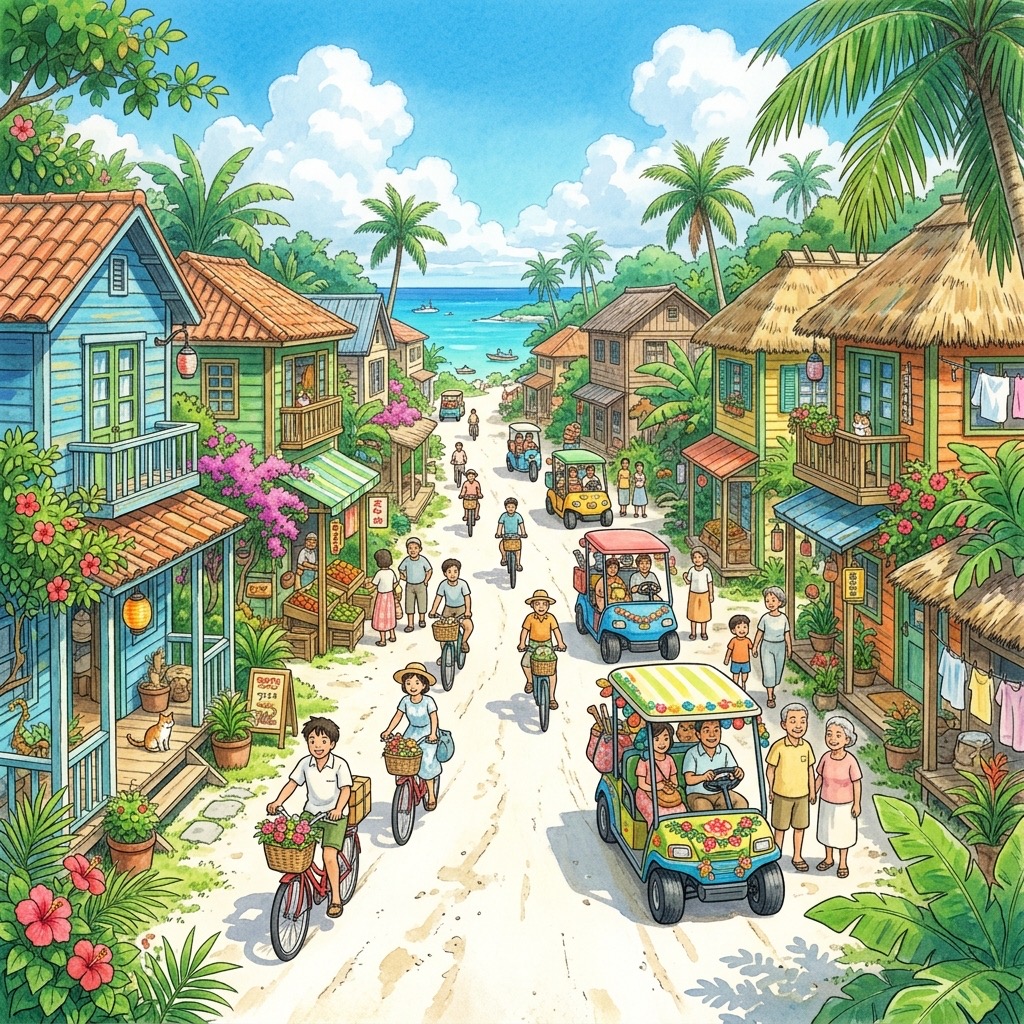
The absence of cars changes everything. On Holbox there is no traffic, no stoplights, no honking. The entire island operates at human scale: you get around on foot, by bicycle, or in a golf cart along white sand streets where children play freely because there are no curbs to need. That lack of engines transforms the experience of every activity — walking to the beach is not a commute, it is part of the journey.
Everything starts at the pier. The ferry from Chiquila docks facing the main plaza, and a few steps from there begins Calle Igualdad, the town's main artery where tour operators, restaurants with tables in the sand, and hand-painted artisan shops line both sides. From that same pier, every water excursion departs: the Three Islands tour, whale shark expeditions, boats to Cenote Yalahau, and the nighttime bioluminescence kayaks. No matter which activity you choose, the starting point is always the same.
To the northeast of the island, Punta Mosquito is flamingo territory. You are required to maintain 150 to 300 feet (50 to 100 meters) of distance — the birds startle easily and their feeding habitat is fragile. You can get there by bicycle (about 40 minutes along a sandy path) or by guided tour. At the opposite end of the spectrum is Cenote Yalahau, a freshwater spring of crystalline clarity reached by a 20-minute boat ride. Swimming in cool, transparent freshwater after days of salty beach immersion is a contrast few visitors anticipate but everyone appreciates.
Sunny beach day
When the Weather Is Perfect
A calm, sunny day on Holbox opens up the full menu of activities. This is when you want to be on or in the water.
Three Islands Tour ($30-45 USD) — A half-day ecosystem tour visiting Isla Pajaros (a bird sanctuary with frigate birds, cormorants, and herons nesting in the mangroves), Isla de la Pasion (a small beach for swimming and relaxing), and Cenote Yalahau (a natural freshwater spring surrounded by jungle). Operates year-round in protected waters. This is the single best value excursion on Holbox and ideal for your first full day on the island.
Flamingo watching at Punta Mosquito — The flamingos are year-round residents, not seasonal migrants. But the best viewing is before 9 AM, when the birds feed in the shallow tidal flats before the heat and wind pick up. Arrive early by bicycle or golf cart. Maintain distance — binoculars make the difference between a memorable observation and a frustrating one where the birds keep retreating. The walk itself, across wide sandbanks with ankle-deep water, is half the experience.
Stand-up paddleboarding — Rentals available on Playa Norte for $15-25 USD per hour. The shallow, calm water makes Holbox one of the best places in Mexico for beginners. You can paddle hundreds of meters from shore and still be in waist-deep water.
Whale shark swimming (May 15 - September 17) — The signature experience of Holbox. A 7-8 hour open-ocean expedition ($170-200 USD plus $12 USD CONANP wristband) regulated by federal norm NOM-171. Maximum two swimmers per whale shark, no touching. Boats depart at 6 AM and head to deep water north of the island where the world's largest fish congregate to feed on plankton. Book at least 3-5 days in advance during peak season. Physically demanding — open ocean conditions, long boat ride, strong currents while snorkeling beside 30-foot animals.
Rainy day
When It Rains (And It Will)
Holbox receives significant rainfall from June through October, typically in short, intense afternoon bursts. Rain does not mean a ruined day — it means a different kind of day. The mornings are usually clear even during rainy season, so front-load your water activities early.
Street art walk — Holbox has one of the densest concentrations of murals per square meter of any small town in Mexico. The street art is not decorative filler — it includes large-scale works by internationally recognized artists, many painted during the annual Holbox Street Art Festival. A self-guided walk through the sand streets takes 2-3 hours and provides some of the best photography opportunities on the island. Rain actually enhances the colors.
Food scene — Holbox punches far above its weight for a town of 2,000 residents. Start with fish tacos at one of the street carts near the plaza ($2-4 USD each), graduate to ceviche at a beachfront restaurant ($8-15 USD), and finish with contemporary Mexican cuisine at one of the upscale spots on Calle Tiburon Ballena ($25-50 USD per person). Lobster pizza at local pizzerias is a Holbox invention and worth trying at least once ($15-25 USD). A rainy afternoon is the perfect excuse for a leisurely three-restaurant crawl.
Mangrove kayaking ($25-40 USD) — This works in light rain and is actually more atmospheric when the sky is overcast. Guided tours paddle through the canal systems of the mangrove forest, where the water is crystalline, the silence is total, and you are sheltered from wind by the canopy. Wildlife spotting improves in cooler, overcast conditions — birds are more active, and the mangrove crabs emerge from their burrows.
Holbox market and town exploration — Wander the small local market for fresh fruit, local honey, and handmade hammocks. Visit the town church, watch fishermen unload the day's catch at the pier, and stop at a mezcaleria for a tasting. Holbox town itself is a destination, not just a base for excursions.
Windy day
When the Norte Blows
Nortes — cold fronts from the north — bring winds of 25-37 mph (40-60 km/h) that cancel all water tours and make the beach inhospitable. They last 1 to 3 days and occur primarily from October through March. These days are when most tourists feel stranded. They should not.
Bicycle exploration of the island — Rent a bike ($6-8 USD per hour) and ride the sandy streets of the town, then head east along the coast toward Punta Mosquito. The wind at your back on the outbound ride makes it effortless. The terrain is completely flat, there are no cars, and you see parts of the island that most visitors miss entirely — abandoned structures reclaimed by sand, wild stretches of empty beach, and mangrove inlets teeming with birds.
Punta Mosquito trek — The 4-5 kilometer (3-mile) walk to Punta Mosquito is one of the most underrated experiences on Holbox. On a windy day, the drama of the landscape intensifies: sand blowing across the tidal flats, waves crashing on the exposed north shore, birds hunkered down in the mangroves. Bring water, sun protection, and closed-toe shoes. The walk takes about an hour each way on the sandy path.
Bioluminescence kayak (evening, if conditions allow) — Wind cancels bioluminescence tours when the sea state is too rough, but moderate wind is manageable. If your operator confirms the tour is running, windy-day bioluminescence can actually be more intense because the wave action agitates more dinoflagellates. Tours run after 8 PM and cost $40-70 USD per person. Check moon phase — this matters more than wind.
Horseback riding ($45-70 USD) — Beach rides operate in most wind conditions except extreme nortes. Sunset rides along the windswept shoreline have a raw, cinematic quality that calm-day rides lack. Operators are experienced with the wind and adjust routes accordingly.
Seasonal activities
What Runs When
Not everything is available all year. Holbox has marked seasonality that determines what you can do on any given visit. Planning with this information prevents disappointment and maximizes each season.
Year-round: Three Islands tour, mangrove kayaking, bicycle rental, horseback riding, street art, food scene, bird watching (150+ documented species), Cenote Yalahau, stand-up paddleboarding (weather permitting).
May 15 - September 17: Whale shark swimming. Regulated by federal law. The single biggest draw for summer visitors and the reason Holbox fills up in July and August.
April - October (peak): Flamingo concentration at Punta Mosquito. The birds are present much of the year, but their numbers peak during these months when they feed intensively in the shallow tidal pools.
March - November (variable intensity): Bioluminescence kayak tours. Best June through August during new moon phases. Operators may suspend tours in winter when dinoflagellate activity drops below visible thresholds.
June through August: peak everything. This is the window where the most activities overlap. Bioluminescence hits maximum intensity, whale sharks are in full season, flamingos are concentrated, and the weather is hot but stable. The tradeoff: highest prices, fully booked tours, and the need to reserve days in advance for anything popular.
Common myths
Myths vs. Reality
"There's nothing to do on Holbox beyond the beach."
Holbox has at least 12 distinct activities: whale shark swimming, bioluminescence kayaking, Three Islands tour, mangrove kayaking, flamingo watching, horseback riding, cycling to Punta Mosquito, Cenote Yalahau, bird watching, street art walking, the food scene, and kiteboarding. The real problem is that many visitors arrive without planning and spend their entire stay in a hammock — not because there are no options, but because they did not research before coming.
"All tours operate year-round."
Whale shark tours only operate May 15 through September 17 by federal regulation (NOM-171). Bioluminescence has an optimal season from June to November. Flamingos concentrate at Punta Mosquito primarily April through October. And nortes cancel every water-based activity for days at a time in winter. Checking seasonal availability before booking flights is the difference between an extraordinary trip and a major disappointment.
"The Three Islands tour and the whale shark tour are similar."
They are completely different experiences. The Three Islands tour is a half-day ecosystem excursion ($30-45 USD) visiting Isla Pajaros, Isla de la Pasion, and Cenote Yalahau. It operates year-round in protected waters. The whale shark tour is a 7-8 hour open-ocean expedition ($170-200 USD) searching for the largest fish on Earth. It only operates 4 months per year and requires a CONANP wristband ($12 USD). One is a relaxed outing; the other is an oceanic adventure.
"Bicycles are just for tourists."
The bicycle is the primary mode of transport for locals. Holbox residents pedal to school, to work, to the pier, and to buy tortillas. The packed-sand streets are perfect for cycling without pavement. Renting a bike at $6-8 USD per hour is the best investment of the trip: it gives you total mobility across the island, gets you to Punta Mosquito without depending on a tour, and lets you move at the real pace of the community.
Frequently asked questions
What people ask
What to do on a rainy day?
Local cuisine, explore town by bike in the rain, mangrove kayaking (rain doesn't affect the mangrove tunnels).
What's the must-do activity?
Depends: May–September whale sharks. July new moon bioluminescence. Any month: the Three Islands Tour ($30–$45 USD).
Can you see flamingos year-round?
Yes, they're residents. Highest presence April–October. Best time: before 9am or before 4pm during low tide.
Is there snorkeling without the whale shark tour?
Beach snorkeling is unspectacular. Cabo Catoche on an independent tour ($55–$85 USD) is significantly better.
Do I need to book in advance?
In high season yes (1–2 weeks, especially whale sharks). In low season you can book the day before.
Next step