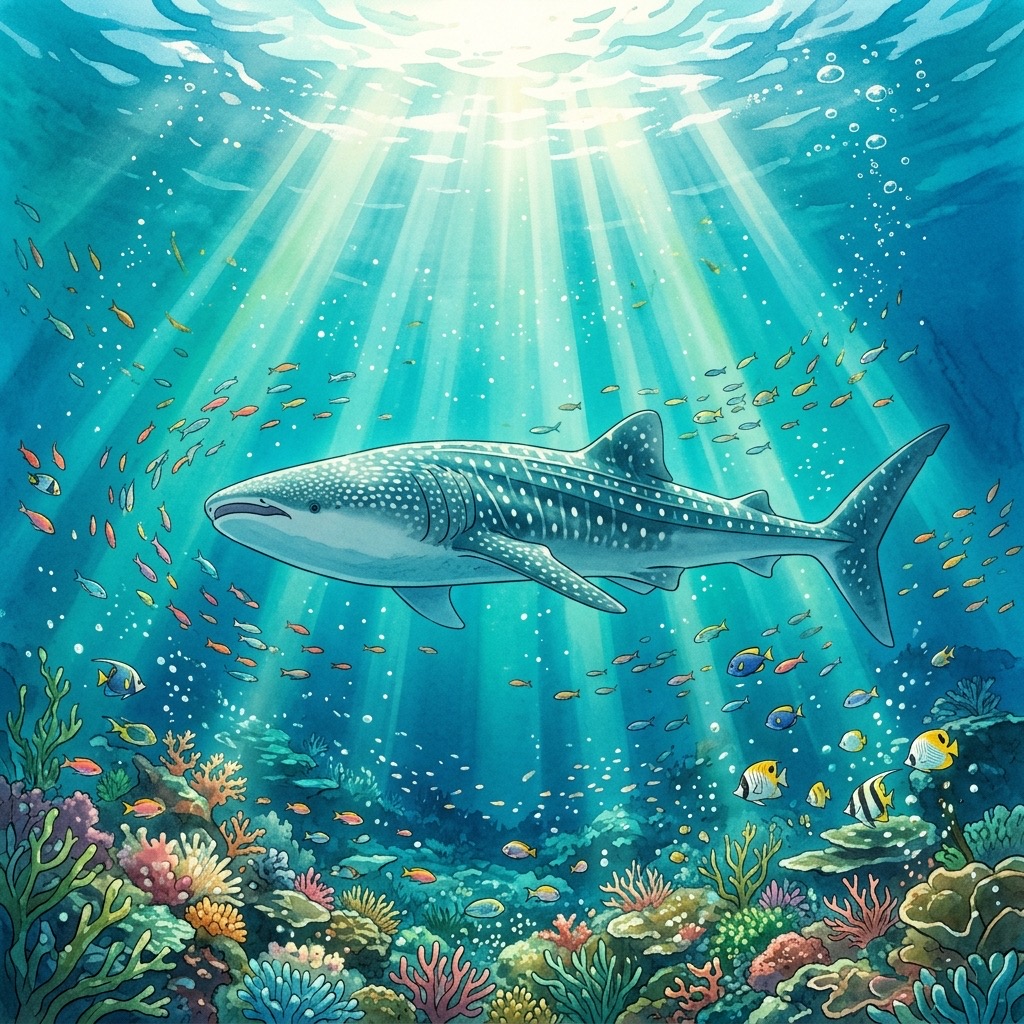
The experience
Swimming with the largest fish on Earth
Preparation starts the night before. You set out your swimsuit and a Dramamine tablet on the nightstand, because the alarm goes off at 5:30 AM without mercy. Breakfast is light: fruit, crackers, water. Your stomach needs to be settled for what lies ahead. By 6:45 or 7:30, depending on the operator, you are standing on the Holbox pier with mineral sunscreen already applied, life vest on, and a cocktail of excitement and sleep deprivation that the village coffee did not fully resolve.
The boat heads for Cabo Catoche and the ride takes roughly two hours. At first the water is murky green, the color of the lagoon and mangrove estuary. Gradually it shifts: jade, then turquoise, then a deep blue that signals open sea. The captain reads the water, scanning for dark patches of plankton that betray the presence of whale sharks. When he spots one, the boat slows and begins circling the area with care.
Then comes the moment. The guide says "in the water" and you slide over the side with your mask and snorkel. Your heart pounds. You swim a few meters and suddenly it appears: a shadow thirty feet long gliding slowly beneath you, its mouth open to the size of a dining table, filtering tons of emerald-green water dense with plankton. The whale shark does not look at you, does not swerve away in alarm. It simply continues on its path with a calm that disarms. You are swimming alongside the largest fish on the planet and the animal ignores you with absolute elegance. Each encounter lasts two to five minutes before the shark changes course or dives, and a typical tour provides four to eight opportunities to enter the water.
The ride back is different. With adrenaline fading, the captain pulls out the fresh ceviche he prepared that morning: catch of the day with red onion, lime, habanero pepper, and cilantro, served on tostadas while the boat points back toward Holbox. Some tours make a stop at a reef for additional snorkeling or at Isla Pajaros (Bird Island), a tiny mangrove islet packed with frigatebirds and cormorants. You arrive at the pier between 1:00 and 2:00 PM, sunburned, salt-crusted, and wearing the kind of grin that does not fade for days.
Season details
When to see whale sharks
May 15 through mid-June: early season. The first whale sharks arrive at Cabo Catoche following plankton currents. Concentrations build gradually, starting with scattered sightings that increase each week. Groups are smaller, there are fewer boats on the water, and the experience feels more intimate. This is a strong choice if you value tranquility over guaranteed massive aggregations. Water visibility tends to be excellent.
Mid-June through August: peak season. This is when the spectacle reaches full scale. Between 800 and 1,400 individuals concentrate in the feeding zone north of the peninsula. Sighting probability on calm-weather days is effectively 100 percent. Demand is highest: book two to four weeks in advance, especially for July weekends and late August. If we had to pick one window, the second half of June offers the best balance between shark concentration and tourist saturation.
September 1 through 17: late season. Concentrations diminish as the sharks begin their migration. Weather becomes less predictable due to hurricane season, and cancellations for rough seas are more common. Memorable encounters still happen, but you need to arrive with the mindset that the ocean decides, not your itinerary.
September 18 onward: season closed. NOM-171-SEMARNAT-2018, the federal regulation governing whale shark observation in Mexico, sets September 17 as the official closing date. From September 18 onward, no legal tours operate. Any operator offering whale shark swims outside the official season is breaking the law.
Tour logistics
- Departure: between 6:45 and 7:30 AM from the Holbox town pier.
- Transit: approximately 2 hours to the Cabo Catoche feeding zone.
- Total duration: 7 to 8 hours (transit, swimming, snorkeling, return).
- Price: approximately $170 USD per person. The CONANP conservation fee of $12 USD (215 MXN) is sometimes charged separately.
- Sunscreen: ONLY mineral sunscreen (zinc oxide or titanium dioxide) is permitted. Chemical sunscreen is prohibited inside the Whale Shark Biosphere Reserve.
- Included: snorkel equipment, life vest, certified guide, lunch (fresh ceviche), and beverages.
- Group size: regulations mandate a maximum of 2 swimmers plus 1 guide per whale shark at any time.
CONANP regulations and NOM-171-SEMARNAT
The federal regulation NOM-171-SEMARNAT-2018, published in the Diario Oficial de la Federacion (DOF), governs every aspect of whale shark tourism in Mexican waters. Key rules include: maximum 2 swimmers plus 1 guide per shark, minimum distance of 16 feet (5 meters) from the tail, no touching, no flash photography, no scuba diving (snorkel only), and mandatory use of life vests. Boats must carry a valid CONANP permit and display the authorization hologram. The regulation exists because Cabo Catoche hosts one of the largest whale shark aggregations in the world, and uncontrolled tourism could disrupt feeding behavior and push the animals to other locations.
Enforcement is real. CONANP inspectors and Mexican Navy (SEMAR) patrols operate in the feeding zone during peak season. Boats without permits can be impounded and operators fined. As a traveler, your responsibility is straightforward: verify that your operator has a current CONANP permit before booking, and follow every instruction the guide gives you in the water.
Planning
Practical considerations for your trip
Motion sickness: The two-hour boat ride to Cabo Catoche crosses open water and can be rough, especially on days with wind. Take Dramamine or meclizine 30 to 60 minutes before departure. Ginger tablets are a natural alternative but less reliable for open-ocean conditions. Sit at the back of the boat, look at the horizon, and avoid looking at your phone.
Snorkeling experience required? No formal certification is needed, and life vests are mandatory for all participants. However, you should be comfortable floating in deep, open water with no bottom visible beneath you. The ocean at Cabo Catoche is 30 to 60 feet deep with potential current. If you have never snorkeled before, practice in the calm waters of Playa Norte for a day before the tour.
Day trip from Cancun: Technically possible but brutal. The drive from Cancun to Chiquila is two hours, the ferry is 30 minutes, and the whale shark tour itself is seven to eight hours. That means leaving Cancun at 4:00 AM and returning after 6:00 PM, exhausted. Some Cancun-based operators run tours directly from Isla Mujeres or Puerto Juarez to Cabo Catoche, cutting out the Holbox transit entirely. If your only goal is whale sharks and you are based in Cancun, those operators may be more practical. But if you want the full Holbox experience, stay on the island at least two or three nights.
What to bring: Mineral sunscreen (applied 30 minutes before departure), a hat for the boat ride, a dry bag for your phone, a GoPro or waterproof camera (no flash), water, and a light long-sleeve rash guard to prevent sunburn during the seven-plus hours on open water. The sun at this latitude is no joke, and you are exposed for the entire trip with no shade on most boats.
Common myths
Myths vs. reality
“The season ends September 15.”
NOM-171-SEMARNAT-2018, the federal regulation governing whale shark observation in Mexico, sets September 17 as the official closing date. Many websites and operators repeat September 15 out of habit, but the current regulation grants two additional days. If your trip falls between September 15 and 17, you are still within the legal season.
“Whale sharks are dangerous.”
The whale shark (Rhincodon typus) is a filter feeder that eats exclusively plankton, krill, and small fish. It has no functional teeth for biting and its behavior toward humans is entirely passive. The only minor risk is an accidental tail strike, avoided by maintaining the regulation distance of 16 feet (5 meters) from the caudal fin. In decades of whale shark tourism in Mexico, not a single attack has been recorded.
“All tours are the same, so book the cheapest one.”
NOM-171-SEMARNAT-2018 specifies mandatory equipment, guide certification, maximum boat size, and the number of people per shark (2 swimmers plus 1 guide). Budget operators often cut corners on safety, use unpermitted boats, or put more people in the water than allowed. Before booking, verify the operator holds a current CONANP permit and that the boat displays the authorization hologram. A reputable tour at $170 USD is a fundamentally different experience from a cut-rate $90 operation that ignores the regulations.
“Using regular sunscreen is just a recommendation.”
It is not a recommendation. It is a prohibition. Chemical sunscreen containing oxybenzone, octinoxate, or avobenzone is banned inside the Whale Shark Biosphere Reserve. Only mineral sunscreen based on zinc oxide or titanium dioxide is permitted. Reputable operators check your sunscreen before boarding and can refuse you the tour if you have chemical products. These chemical filters damage the plankton that whale sharks feed on and disrupt the ecosystem that makes their presence possible in the first place.
Frequently asked questions
What people ask
How much does the whale shark tour cost?
About $170 USD per person + $12 USD CONANP fee. Private tours $450–$850 USD.
Is there a guarantee of seeing whale sharks?
During peak season (Jun–Aug), sighting rates exceed 90%. With 800–1,400 specimens at Cabo Catoche, odds are very high.
Can I swim if I'm not a strong swimmer?
Yes. It's surface snorkeling, not diving. Guides help inexperienced swimmers.
What should I bring?
Mineral sunscreen (required, no chemical), swimsuit, towel, water, seasickness medication, waterproof camera.
Can I do the tour as a day trip from Cancun?
Yes, but it's 14–15 hours. Most visitors prefer staying at least one night.
Next step